
MELD-Na Score
Gastroenterology
MELD-Na for CLD
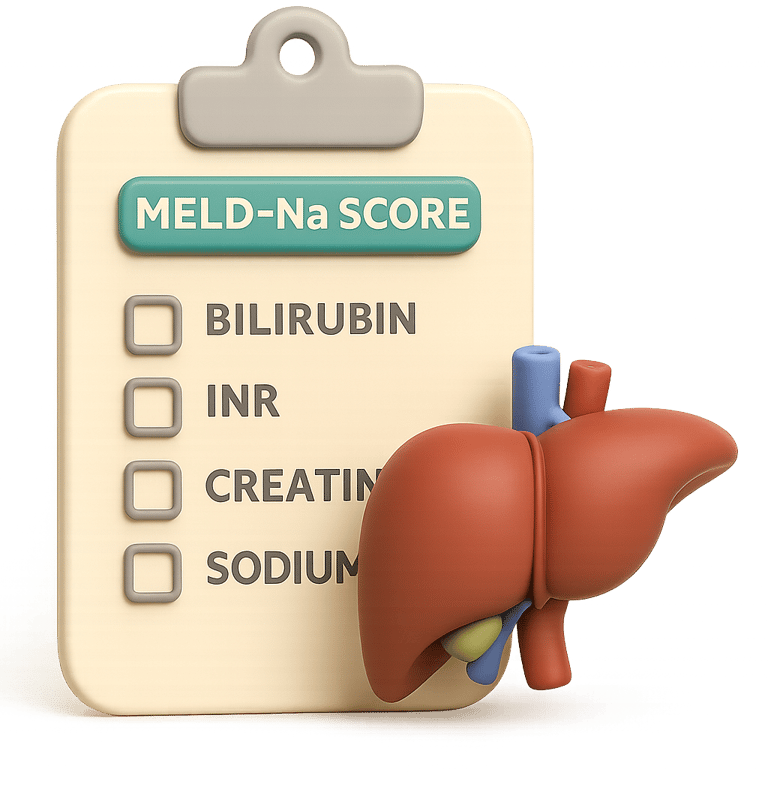
The Model for End-Stage Liver Disease incorporating sodium (MELD-Na) score is a vital prognostic tool used to assess the severity of chronic liver disease and prioritize adult patients (aged 12 and older) for liver transplantation.
FUNCTION:
The MELD-Na score is an evolution of the original MELD score, which was initially developed to predict 3-month mortality in patients undergoing Transjugular Intrahepatic Portosystemic Shunt (TIPS) procedures. Recognizing its effectiveness in predicting short-term survival in cirrhosis, it was adopted by the United Network for Organ Sharing (UNOS) for transplant allocation in 2002.
CALCULATION:
The score integrates serum values of bilirubin, creatinine, and International Normalized Ratio (INR) with serum sodium (Na) levels. Sodium was included because hyponatremia (low sodium) was identified as an independent predictor of mortality in cirrhosis.
Scores range from 6 to 40, with a higher score indicating a greater risk of 3-month mortality and thus a higher priority for transplantation.
ADVICE:
Consider referral to hepatologist or liver transplant center for patients with MELD Score ≥10.
MELD Score should be periodically re-assessed, as it changes with changing lab values.
All cirrhosis patients should be periodically screened for hepatocellular carcinoma with serum alpha-fetoprotein (AFP) and by appropriate imaging to see if they can earn “standard MELD exceptions”.
CRITICAL ACTIONS
Standard MELD Exceptions
The following conditions are automatically assigned a MELD Score of 22 (28 in case of hyperoxaluria), with a 10% increase in score every 3 months from diagnosis.
Hepatocellular carcinoma (HCC) with one lesion between 2 - 5 cm or two to three lesions <3 cm (Milan criteria), provided no vascular invasion or extrahepatic disease.
Hepatopulmonary syndrome with PaO2 <60 mmHg on room air.
Portopulmonary hypertension, with mean pulmonary artery pressure (mPAP) >25 mmHg at rest but maintained <35 mmHg with treatment.
Hepatic artery thrombosis 7–14 days post-liver transplantation.
Familial amyloid polyneuropathy, as diagnosed by identification of the transthyretin (TTR) gene mutation by DNA analysis or mass spectrometry in a biopsy sample and confirmation of amyloid deposition in an involved organ.
Primary hyperoxaluria with evidence of alanine glyoxylate aminotransferase deficiency (these patients requires combined liver-kidney transplantation).
Cystic fibrosis with FEV1 (forced expiratory volume in 1 second) <40%.
Hilar cholangiocarcinoma.
Blog
From Yangon to UK: Decades of Medicine, Moments of Reflection
LINKS
SUBSCRIBE
© 2025. All rights reserved.